

The Lane Only You Can Walk
There is something leaders are carrying right now that is crushing them.
It is not confusion about AI. It goes much deeper than that.
It is the feeling of having been spun – by experts, by urgency, by the relentless pressure to adapt – until the ground underneath leadership itself stopped feeling solid.
Until the question stopped being how do I lead through this and quietly became do I still know how to lead at all.
That conversation is happening in rooms where leaders feel safe enough to say it. If it sounds familiar, keep reading. Because this is not an article about AI. It is an article about you – and the moment you are standing in right now.
The Noise That Got Us Here
The moment AI became impossible to ignore, the experts arrived.
Frameworks. Playbooks. Prompt libraries. Adoption roadmaps built on tools already outdated by the time the curriculum was written. Every week a new pivot. Every month a new imperative. The volume and velocity of guidance created something that looked like momentum but felt, to most leaders, like circles.
Underneath the expert noise, a quieter institutional scramble. Lawyers and governance teams writing policy for something that moved faster than policy has ever moved. The early internet took years to outpace regulation. AI outpaced it before most organizations finished their first internal committee meeting.
Here is what leaders need to hear plainly: everyone is behind.
The consultants, the technologists, the regulators – all of them are navigating the same moving ground with the same incomplete maps. The expert certainty being sold right now is, in most cases, dressed-up improvisation.
What there is shame in – eventually – is continuing to look outward for an answer that was never going to come from out there.
The Honest State of Things
AI is already inside your organization. Not theoretically. Right now, today.
Your teams are using it to draft, research, synthesize, and decide – some openly, some secretly, some in ways that never surface in a meeting or a report. Attempting to pull it back will not create compliance. Among younger workers especially, it will create resentment toward leadership that feels out of touch with how real work gets done.
So the question is not whether AI is inside your teams. It is. The question is what kind of leader you are going to be inside an organization where the machine is already at the table.
Answering that well requires understanding what the machine actually is – and what it is not.
What AI Cannot Do – And Why That Changes Everything
AI is backward-looking by design.
It is trained on everything that has already been written, said, recorded, and decided. It finds patterns in that existing material and generates – with remarkable sophistication – what should logically come next.
It is a mirror of the past.
Powerful, useful, genuinely impressive. But a mirror nonetheless.
It cannot sit with a moment that has never existed before.
And leadership lives almost entirely in moments that have never existed before.
- When a team loses confidence in a direction and nobody is saying it yet, a leader feels that before they can name it.
- When a decision requires weighing what is strategically right against what is humanly right, a leader holds that tension in a way no prompt can replicate.
- When someone walks in carrying something they have not said to anyone else, a leader reads the room – not from pattern recognition but from presence, from relationship, from knowing that person across time.
Wondering. Weighing. Sensing. Discerning.
These are not soft competencies on the edge of leadership. They are the center of it. They are what enables a leader to walk into a room of people who are scared, resistant, or losing faith – and shift something. Not by having the right answer. By being the right presence.
That territory belongs to a different kind of intelligence. One not built from data. Built from living – from decisions made under pressure, relationships navigated with care, failures absorbed and carried forward, and character formed in the places where no one else was watching.
That is not replaceable. That is the lane only you can walk.
What Is Quietly Happening Underneath
In the race to adapt, many leaders have begun doing something they did not intend.
They have started leading like machines.
Faster output. More content. Optimized messaging that is technically correct and emotionally absent. The pressure to produce at the pace AI makes possible has pulled leaders toward the exact behaviors the machine performs best. And the further into that pull, the more something essential gets quietly vacated.
The result is visible if you know where to look. Organizations that once had distinct voices and human cultures starting to sound like each other. Teams executing without feeling led. Decisions that are efficient and somehow hollow.
And underneath all of that – something leaders are carrying but rarely saying.
A growing sense of performing leadership rather than inhabiting it. Of being present on the calendar and absent from the room. Of moving fast and somehow not moving toward anything that matters.
Here is what makes this genuinely dangerous: as AI takes on more tasks, it creates real margin. Time and cognitive space that was previously consumed. And that margin is an invitation.
But most leaders are not accepting the invitation. They are filling the margin right back up – more output, more tasks, more optimization. And in doing so, without realizing it, they are allowing AI to train them. To become more productive, more efficient, more machine-like. And less present, less human, less themselves.
That is the real threat. Not that AI replaces leaders. That leaders replace themselves.
The Relinquishment
AI can produce a great deal of what once required human effort. And yes – it can generate responses that sound empathetic. In a chat window, in certain moments, it can approximate something that resembles being heard.
But there is a difference between a response that sounds like presence and a room where presence is actually felt.
When someone is really struggling – not performing struggle but carrying something that is costing them – they do not need accurate language. They need a human being who has been in hard places themselves. Whose response is shaped not by training data but by genuine care, formed character, and the willingness to stay in the discomfort without rushing to resolve it.
That moment is what leaders are built for. It is not a feature of good leadership. It is the thing that earns everything else – trust, loyalty, the willingness of people to surface real problems before they become crises.
So here is the relinquishment this moment is asking for.
Let the machine carry what it can carry. Give it the tasks, the production, the drafting, the synthesis. Every task it absorbs is margin returning to you.
That margin is not meant to be filled back up. It is meant to be used for the work only you can do.
Presence. Real conversation. The slow, unglamorous, high-stakes work of knowing people well enough to lead them well. The development of judgment that only comes from staying human when the pressure is to optimize.
That is not a productivity strategy. It is a leadership identity.
The Call
This is an inflection point. Not just for organizations. For leaders personally.
Every significant revolution in how we work eventually surfaces the same question underneath everything else.
Who am I here – and what am I actually for?
AI is asking it again – more urgently, more personally, and with less patience for leaders who would prefer to keep it at a safe distance.
The leaders who will matter most are not the ones who adopted the tools fastest. That advantage will commoditize. The leaders who will matter are the ones who stayed deeply, irreversibly human. Who treated the margin AI created as an invitation to lead more fully rather than produce more efficiently. Who built presence, judgment, and trust at the exact moment the culture was pulling everyone toward speed and output.
This is the question of significance. Not as a future destination – but as an active choice, made now, in the middle of the revolution.
Your organization does not primarily need you to be its most efficient person. It has tools for that now.
It needs you to be its most human. Its most present. Grounded enough in your own identity to lead others through a moment that has no map.
That is not a framework. That is not something that can be prompted or generated or scaled.
That is you – in the lane only you can walk.
This moment is not asking you to compete with AI. It is asking you to become more fully human in response to it.
A Final Thought
I have been sitting with leaders in this conversation for a while now – across industries, across geographies, in rooms where the same feeling keeps surfacing regardless of context.
The relief when something gets named. The long pause that follows. And then the quiet question underneath it all – about what it means to lead well in this moment, and whether there is still space to be genuinely human in the doing of it.
There is.
That conversation – about who you are as a leader and what you are being called toward – is one I hold as meaningful work.
If you are ready to have it, the space is here.
Note:
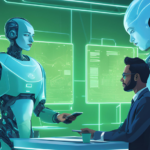
The image accompanying this article was created with the assistance of AI – intentionally.
The point was never to reject the machine.
The point is remembering the human lane only we can walk.